Horsetail – An Ancient Survivor of the Plant Kingdom

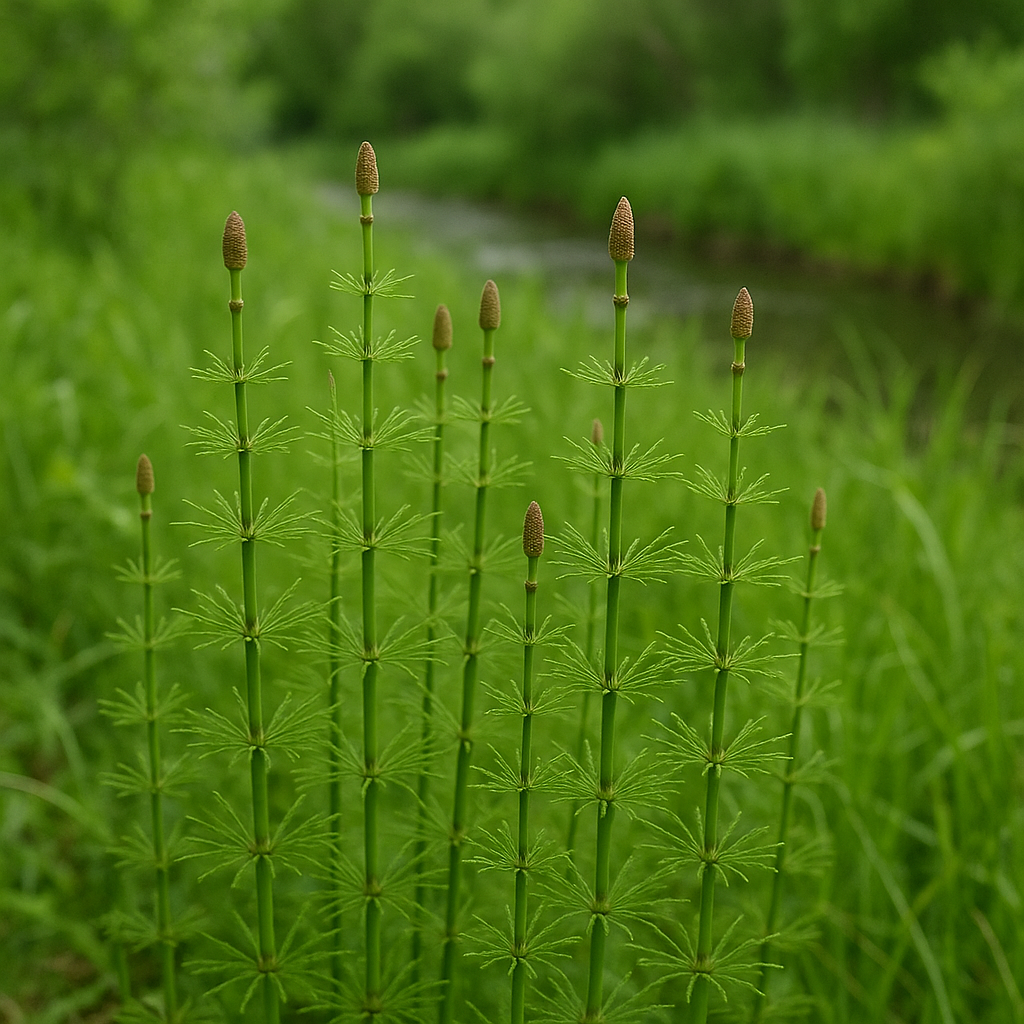
Few herbs possess a lineage as remarkable as Horsetail (Equisetum arvense). Often called one of the oldest living plants on Earth, horsetail is a descendant of prehistoric relatives that once towered over ancient forests more than 300 million years ago. While today’s plants are far smaller, they retain the distinctive jointed stems and segmented appearance that have made horsetail instantly recognizable for centuries. Native throughout much of North America, Europe, and Asia, it commonly grows in moist meadows, stream banks, roadsides, and other damp environments.
Unlike many medicinal herbs prized for their colorful flowers or fragrant leaves, horsetail is harvested primarily for its sterile green stems. These hollow, bamboo-like stalks contain naturally occurring minerals, particularly silica, which has contributed to the herb’s longstanding reputation in traditional herbalism. Historically, the plant’s rough texture also made it useful outside the apothecary, where bundles were used to polish wood, pewter, and cookware, earning it the nickname “scouring rush.”
Horsetail has been valued in European, Native American, and Traditional Chinese herbal practices for generations. Ancient Greek and Roman herbalists documented its use, and medieval physicians continued to include it in their botanical references. As herbal knowledge spread throughout Europe and later North America, horsetail became a familiar ingredient in traditional preparations intended to support overall wellness.
The herb has long been associated with the body’s connective tissues. Traditional herbalists frequently incorporated horsetail into wellness routines intended to support healthy hair, skin, nails, bones, and joints. Because of its naturally occurring silica content, it became one of the most recognized herbs for maintaining structural health and vitality. It has also historically been included in herbal preparations intended to support normal urinary tract function and healthy fluid balance, making it a versatile addition to many traditional formulas.
Today, horsetail is commonly prepared as teas, tinctures, capsules, powders, and dried herb infusions. Many herbalists appreciate it as a foundational botanical whose reputation has endured across cultures and generations. While scientific understanding continues to evolve, its place in traditional Western herbalism remains firmly rooted in centuries of historical use rather than modern medical claims.
Beyond its medicinal history, horsetail serves as a fascinating reminder of Earth’s ancient botanical past. Standing among modern flowering plants, its primitive structure offers a living glimpse into prehistoric landscapes while continuing to occupy an important place in contemporary herbal traditions.
Common Uses
Traditionally used to support healthy hair, skin, nails, bones, connective tissues, urinary tract wellness, healthy fluid balance, and overall mineral nourishment.
Storage
Store in a cool, dry place away from direct sunlight. Keep containers tightly sealed to preserve freshness and maintain the herb’s natural qualities.
About Underground Apothecary LLC
At Underground Apothecary LLC, we believe the wisdom of traditional herbalism deserves to be preserved and shared responsibly. Our carefully selected botanicals are sourced with quality in mind and offered for educational purposes, honoring the rich history of herbal traditions while encouraging informed and responsible use.
FDA Disclaimer
These statements have not been evaluated by the Food and Drug Administration. This product is not intended to diagnose, treat, cure, or prevent any disease. The information provided is for educational purposes only and reflects historical and traditional herbal use.